Hippocrates


Greek physician Hippocrates of Cos (circa 460-377 B.C. ) is often called the "father of medicine". His contributions to medicine include detailed observations of disease and its effects, and an understanding of how health is often influenced by diet, breakdowns in bodily processes, and the environment.
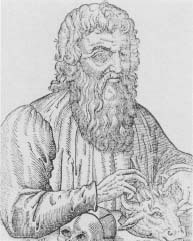
Hippocrates. His contributions to medicine include detailed observations of disease and its effects, and an understanding of how health is often influenced by external factors.

Facts about the life of Hippocrates are rare. Some information, however, is consistent. Hippocrates was bom on the island of Cos into a family of doctors. He taught at the widely-regarded medical school on the island and traveled widely throughout ancient Greece and the Mideast giving lectures. Quite famous during his lifetime, Hippocrates died at a fairly old age in Larissa.

In his school, Hippocrates tried to separate medical knowledge from myth and superstition. Modern knowledge about Hippocrates' methods comes from the Corpus Hippocratum, a collection of 70 volumes that seems to have been gathered in the great Library of Alexandria around 200 B.C. While few of these books were probably written by Hippocrates himself, they are widely considered to be an expression of his medical teachings and philosophy.

The Hippocratic approach to medicine emphasized diet and the clinical examination of biological functions. In his lectures and teachings, Hippocrates noted that the environment can affect health in both positive and negative ways. He also advanced the idea of the "four humors," whereby disease was supposed to result from an imbalance in the body's four important fluids.

Hippocrates is credited with writing about preventive medicine. He and his followers were very concerned about preserving health through proper diet and activities, such as exercise and getting enough rest.

Hippocrates was not content to simply work on the causes and treatment of disease. He advised medical practitioners to be serious about their profession and have high moral standards. These standards are embodied in what we call the "Hippocratic Oath," which doctors still swear to today. According the Oath, a physician is required to swear to use his knowledge only to save a life, not to take it; not to cause abortion; to maintain a professional relationship with patients; and not to reveal secrets given to him by patients.


User Contributions:

Ashley
Report this comment as inappropriate
Apr 15, 2008 @ 4:16 pm
WOW!! I am truly impressed with this website! As of now I have been fairly interested in the contents of Hippocrates! A truly fascinating person, indeed he is! So amazing how he figured out about the organs in our body! Having done such big research on him i learned that it is always smart to learn how things came to be now! Thats why i am so glad that i decided now to take a part in some way with history, because truly everything here does matter and is a big part of our life today, school projects are always fun to do on ancient greeks. they always seem to have the biggest backgrounds and biggest knowledge eligible to Americans today!!!
Audrie
Report this comment as inappropriate
May 20, 2008 @ 4:16 pm
I'm doing a school project on Hippocrates, and he seems really smart, but I need to know artifacts I can use for him. You see, our projuect requires to find 5 artifacts (fake, of course) and to bring them in to represent him.
Chocolate
Report this comment as inappropriate
May 21, 2008 @ 8:20 pm
I love your article. It's very informative. I learned a lot about Hippocrates and about why he has been called as the "father of medicine". I also like your picture of Hippocrates. I'm studing about Ancient Greece right now, so, your article is very helpful. Thanks for helping me out!
Don
Report this comment as inappropriate
Oct 2, 2008 @ 3:03 am
Thanks for ur article i may be getting a A thanks alot this is kinda intresting
titus
Report this comment as inappropriate
Jan 28, 2009 @ 4:04 am
truly hippocrate was a father of medicine .i have learned alot through this his interesting contribution toward pathology. thank alot hippocrate u av influence life of many through ur work.
ELLA
Report this comment as inappropriate
May 12, 2009 @ 9:21 pm
i REALLY ENJOYED IT COOL ARTICLE I THINK I WILL COME AGAIN. YOU GUYS ROCK KEEP DOING WHAT YOU ARE DOING!!
chow
Report this comment as inappropriate
Sep 21, 2009 @ 4:04 am
thanks for this x helped me write my essay on Hippocrates x
Kirsten
Report this comment as inappropriate
Dec 12, 2009 @ 7:19 pm
I am doing a school project, in which I have to do a science fair of one of Hippocrates's inventions/discovery, but I can't figure out what to do. I know that he invented the Hippocratic Oath and he was the father of medicine, but i need a diagram of one of his inventions. Please help!
Noofyourbeezwax
Report this comment as inappropriate
Dec 18, 2009 @ 11:11 am
Omg thankkyou so much!
Becausee im in 7th grade and doingg a project on this for greek arete.
And i havent read it yet but i was bored so i decided to write here before reading it!
kahyybyee.
Report this comment as inappropriate
Mar 4, 2010 @ 3:15 pm
i really loved reading about Hippocrates and since now i am doing a project in 7 grade i will rite abotu Hippocrates and all the things he has done and i know i will get an 100

Comment about this article, ask questions, or add new information about this topic:

CAPTCHA


Hippocrates forum