Artificial skin
Artificial skin is a synthetic (laboratory produced) substitute for human skin that can dramatically save the lives of severely burned patients. Skin, composed of two layers called epidermis (the outer layer) and dermis (the inner layer), is the largest human organ. It covers the entire body, keeping harmful bacteria out and vital fluids in. The epidermis is the outer layer; the dermis is the inner layer that contains the blood vessels, nerves, and hair, oil, and sweat glands.
A severe burn leaves the body dangerously vulnerable to infection and dehydration (drying out). Keeping burn patients in sterile (germ free) rooms can protect against infection, and covering burned areas with grafts (a piece of skin or bone transplanted from one area of the body to another) from the patient's own skin or temporary grafts from other humans or pigs can help save some patients. Still, many burn patients die because their bodies cannot produce large quantities of new skin quickly enough, or because their bodies reject the skin grafts.
Burke and Yannas Create Synthetic Skin
The medical community has long been looking for a more dependable alternative. The first synthetic skin was invented by John F. Burke, chief of Trauma Services at Massachusetts General Hospital, and Ioannis V. Yannas, chemistry professor at the Massachusetts Institute of Technology (MIT) in Cambridge, Massachusetts. Burke had treated many burn victims and realized the need for a human skin replacement. Yannas had been studying collagen, a protein found in human skin. Teaming up during the
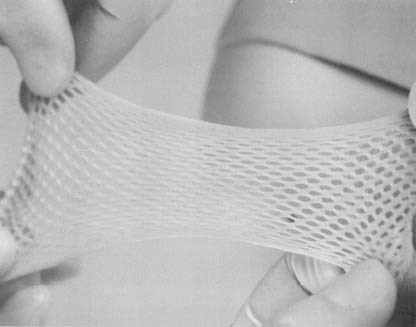
Burke and Yannas then created a kind of artificial skin using polymers from shark cartilage and collagen from cowhide. This mixture was dried and sterilized to make a thin membrane (a covering through which things can pass) similar to the human dermis layer. Added to the membrane was a protective top layer of silicone that acted like the human epidermis.
Burke and Yannas's experiments with their synthetic skin, called Silastic, showed that it acted like a framework onto which new skin tissue and blood vessels could grow (although these new cells never produced hair follicles or sweat glands, which normally form in the dermis). As the new skin grew, the cowhide and shark substances from the artificial skin broke down and were absorbed by the body. In 1979 Burke and Yannas used their artificial skin on their first patient, a woman whose burns covered over half her body. After peeling away the burned tissue, Burke applied a layer of artificial skin and, where possible, grafted on some of her own unburned skin. Three weeks later, the woman's new skin—the same color as her unburned skin—was growing at an amazingly healthy rate.
Graftskin
At nearby Harvard University, Howard Green was culturing human skin cells under sterile conditions and growing a sheet of human epider-mis cells from just a tiny piece of a person's skin. When the cultured skin was placed on a wound area, however, it was rejected by the body's immune system (an internal mechanism for fighting off disease). Green later collaborated with Eugene Bell of MIT, who founded a research group called Organogenesis. The research goal at Organogenesis was to make artificial skin that would both include an epidermis layer and resist rejection by the patient's immune system. Organogenesis teams eventually created an extraordinary product called Graftskin, a living skin equivalent made of purified bovine (ox or cow) collagen into which some of the patient's own dermal cells are "seeded" (placed for growth). On top of this layer is an epidermal layer of cultured human skin cells. The Graftskin is formed into four-by-eight inch sheets that can be sutured (sewn) or stapled onto a patient during surgery.
In clinical trials Graftskin grafts have not been rejected by patients' immune systems. Hospital trials have studied burn victims as well as patients needing skin grafts after cancer surgery, and those with chronic (nonhealing) wounds. After further testing, synthetic skin may become a more common treatment for burns and other serious skin disorders. A welcome side effect of this research is that synthetic skin is a source of human tissue that can also be used to test dermatological (skin) products without lab animals.
or not...
well thank a bit
Thanks
the wound was surgical, due to a Calcaneus Fracture and insertion of titanium plate and screws, The wound seem unable to heal
after 3 months
My name is Sylvia Rosenbloom, I'm Brazilian and I need some help.
I need to know if your company have a synthetic human skin to help Brazilians in Santa Maria (south Brazil) victims of Nightclub Fire. 235 people died last Monday.
I don't work at the hospital, I leave in Maryland and would like to help this people in my country. Those families don't have money to buy it. They really need to find a company to help urgent.
They don't have enough skin to transplant and there is people dying one day after another, they need some to try save about 50 people. All skin they have is enough just to 7.
Please, if you can help let me know. If you can not help, please let me know other companies maybe can do it.
I will appreciate your help.
Thank you very much.
Sylvia Rosenbloom
p.s. I'm sorry about my English, I hope you understand me, If not send me a phone number and I will call you soon. Thanks again.
I need to know if the artificial skin is available in Ontario Canada and the name of the company that makes it, also is it approved by the Ontario health dept and does it have a Din number.
Any help would be appreciated.
john
My mother is 88 years of age she has Alzheimer's and bedridden . What are the chances Artificial skin will close the bed sore . Help
Thank you
Mr. Ronald woodson
9173120231
Where can we get it?