Artificial ligaments
Ligaments are bands of tough, elastic tissue that bind bones together at joints so that they can move. When a ligament is torn, it can either be repaired or replaced. Repair is the first choice, but often a torn ligament heals poorly and must be replaced. Most replacements come from connective tissues in the patient's own body (such as a knee tendon). Rehabilitation and return to full strength can take one to two years.
As anyone who participates in sports or other strenuous activities knows, the knee is very vulnerable to injury. When the knee is subjected to abrupt or progressive stress, one of its four ligaments is likely to tear. Repair or replacement of these ligaments is a major problem. To reduce rehabilitation time and provide greater strength, the W. L. Gore Company developed an artificial ligament made out of Gortex. Gortex is a porous (full of small holes) update of Teflon (a tough material invented in 1969 best known for its use in waterproof materials). The six-inch-long Gortex ligament consists of about 1,000 fibers braided together for strength. The ligament is attached to the bones above and below the knee with stainless steel screws and soon becomes naturally anchored as the bone grows into and through the Gortex.
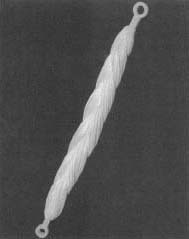
Rehabilitation with the Gortex ligament can be as short as six weeks, and the procedure itself is usually done as outpatient arthroscopic surgery. The Food and Drug Administration (FDA) approved use of synthetic ligaments in humans in 1988. The approval, however, was only for patients who had tried and failed with a natural implant.
[See also Artificial hip ]
I am an elite gymnast, in high hopes for the olympics one day. I have had a very serious shoulder injure. I have had 2 surgies already but I am still having major problems, I was wondering if it is and would be possible to also give or a replacement the ligament in the shoulder, like done with the knee.
thank you very much
These polymers should have same mechanical properties as the ligaments and tendons profess during the motion of the knee.
Thank you and I am looking forward to your answer
Bojan Janevski
I had 3 operations of my knee in the past. Everything is wrecked down there, but I only have one concern about one ore maybe two ligaments that don't hold my knee as they should. They had even been restored by my own ligaments in past (second surgery).
So question is.. eren't artificial ligaments made out of Gortex that are to put into the body harmful to it, and that the body rejects it, even lead to various adverse reactions of body.. because I have heard from doctors to doctors that same story and I am very curious if there is any chance that artificial ligaments actualy exists and are able to restore your old ones? - because it would change averything in my life. thanks for reply and sorry for my english..
I am looking everywhere for help here in australia but I am coming up against brick walls. I also have EDS and my left shoulder has currently been dislocated for the past 5 months, I recently had shoulder stabilization surgery but unfortunately that did not fix the problem as it only lasted for a few days. I am at a point where I need any helpful info that I can get because nobody here in Perth seems to know how to help me. I was interested knowing more about the Gortex which I will google but if anyone could email me more specific info and if it would be helpful to me that would be appreciated.
To Troy Heynsbroek, the laser surgery sounds interesting you said it worked for your shoulders? Where would I find more info on that procedure? I am seriously looking into anything at the moment thats how desperate I am to get this fixed.
I have been able to do most sporting activites and as well as before. I was always told never to ski and road running would not be a good idea and have never done either for fear of injuring my knee. In winter I my knee stiffens up due to the cold and only in the last 6/7 months have I started having considerable problems/pain with my knee but I think this is due to the amount/type of exercise I do (and the fact I am getting older). I have never had any side effect from having the actual artificial ligaments in my knee, any limmitations I have are as a result of having artificial ligaments, no the ligaments themselves. Hope that helps some of you