Heart-Lung Machine


One of the major milestones in medicine was the development of artificial circulation, also known as heart-lung bypass. Before the heart-lung machine was invented, heart surgeons operated blindly, with the heart still pumping, or by slowly chilling the patient's body until circulation nearly stopped, or by connecting the patient's circulatory system to a second person's system during the operation. All of these methods were extremely risky.

Gibbon's Research

An American surgeon named John H. Gibbon Jr. (1903-1974), began pursuing the goal of total artificial circulation in 1931 after a young female patient died of blocked lung circulation. Gibbon realized that it was necessary to keep oxygenated blood circulating without use of the heart, especially to the brain, to carry out careful operations on the heart under direct vision. His pursuit was to last for almost three decades.

After years of intensive experiment, John Gibbon, his wife, Mary, and others were able to construct a heart-lung machine to allow such artificial circulation. On May 6, 1953, surgery using the heart-lung machine was successfully performed on the first human, 18-year-old Cecilia Bavolek, to close a hole between her upper heart chambers. Gibbon's original heart-lung machine was massive, complicated, and difficult to manage. It damaged blood elements and caused bleeding problems and severe consumption of red blood cells. Because of its ability to permit corrective operations to be performed inside the human heart for the first time, however, these drawbacks of heart-lung bypass were considered acceptable. The era of open heart surgery had begun.

Product Improvements

Gradually, the safety and ease of use of heart-lung equipment improved. With today's state-of-the-art machines, minimal blood trauma occurs during heart-lung procedures. It is now commonplace for surgeons to stop the heart from beating for several hours while the circulation is maintained by heart-lung equipment.

Now that patients can be kept alive during heart surgery, a whole new range of operations has become possible. Congenital heart defects (those occurring at birth) can be repaired. Diseased or damaged heart valves can be replaced. Coronary bypass surgery, in which a replacement blood vessel is used to carry blood flow around a blocked section of artery, is commonplace. Thanks to Gibbon's heart-lung machine, open-heart surgery, especially coronary bypass, has become routine throughout the world.

How It Works

Blue blood withdrawn from the upper chambers of the heart is
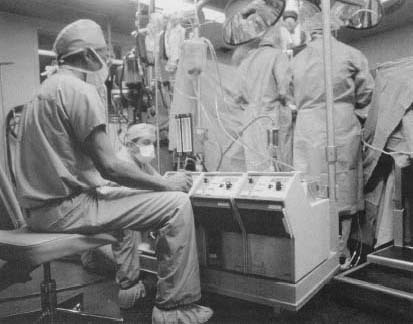
A heart-lung machine. Before the heart-lung machine was invented, heart surgeons operated blindly with the heart still pumping.
siphoned into a reservoir. It is then pumped through an artificial lung to expose it to oxygen. When the blood is passing through the lung (or oxygenator), it comes into close contact with the surfaces of the machine itself. Oxygen gas is delivered to the interface between the blood and the machine, allowing the blood cells to absorb oxygen molecules directly. The blood is now red in color, owing to its rich content of oxygen. The heart-lung machine next pumps the red blood back into the patient through a tube. The heart-lung circuit is a continuous loop: as the red blood goes into the body, blue blood is drained into the pump.


User Contributions:

Zoe Hecht
Report this comment as inappropriate
Jan 4, 2007 @ 5:17 pm
My Grandfather was one of the original inventors of the Heart and Lung Machine. He worked for a Dr. M.M. Ter-Pogossian at Washington University School of Medicine in St. Louis, Missouri. If at all possible, I would greatly like some extra information about how it was invented and why? My daughter is doing a biograpy on my grandfather (Julious Hecht). This web site is very good by the way.
MaryAnn
Report this comment as inappropriate
Apr 25, 2007 @ 8:08 am
Do you have a photograph of Dr John H Gibbons and a photo of the first heart lung machine. I am doing a ppt presentation on the history of heart surgery.
I have in the past attended a conference by Dr Vincent Gott which was truly amazing - And now I find this phenomenal article
Thanks MAry Ann WErtan
Nidhi
Report this comment as inappropriate
May 7, 2008 @ 6:18 pm
I love to see operations of heart ani like to know about heart organ.
If u can send me videos of heart operation and images as well because this is good website that i had ever seen. This will help me on my study. Thank you.
Lynn hogan
Report this comment as inappropriate
Aug 18, 2009 @ 1:13 pm
Has anyone heard of a Baylor - Biel ( spelling uncertain ) h/l machine? Small, piston driven pump, Vietnam era or earlier
Tom
Report this comment as inappropriate
Aug 19, 2009 @ 3:03 am
Hello,my name is Tom. I was doing some curious research on the topic of the heart/lung machine and it's history and I found your site. I hope someone gets back to me with an e-mail. You see I was born in May of 1953, the same month and year Dr. Gibbons did his 1st sucessfull surgery, and I was born with 3 holes in my heart. My surgery was not able to be done until I was age 6 which was in 1959. I was on the Heart/lung machine(Basically Dead)for 51 minutes. I think the whole surgery took about 6 hours. I was told in later years that I was the 2nd sucessful child patient in the US. I am not sure if that's true and looking for some help to find out if this is the case? I was born 5/21/1953 and now am 56 years old, be 57 in May 2010. My surgery was done in LA, CA. at some Ladder Day Saints Childrens Hospital. A book was also written about me called "the Operation" and I would like to find a copy of it. My time is limited now but I am lucky to even be here still and would like to know about all of what happenened to me when I was 9 and had the surgery. I would greatly appreciate any help or information you or you readers can provide.Thank you,Tom M.
paula ballew
Report this comment as inappropriate
Sep 17, 2009 @ 10:22 pm
My sister Debbie Ballew was a major contributor to the Gibbons Heart Lung Machine being purchased for St. Louis Children's Hospital in the 1950's. The PARADE magazine did a story [a campaign] about her ventricular septal defect and the need for the Gibbons Heart Lung machine in St. Louis to save her life and many others in this area. Her story brought in much more money than was needed, but sadly she died soon afterward. I would like a copy of the newspaper that did the story on her. I am so proud of her contribution.

Comment about this article or add new information about this topic:

CAPTCHA


Heart-Lung Machine forum